
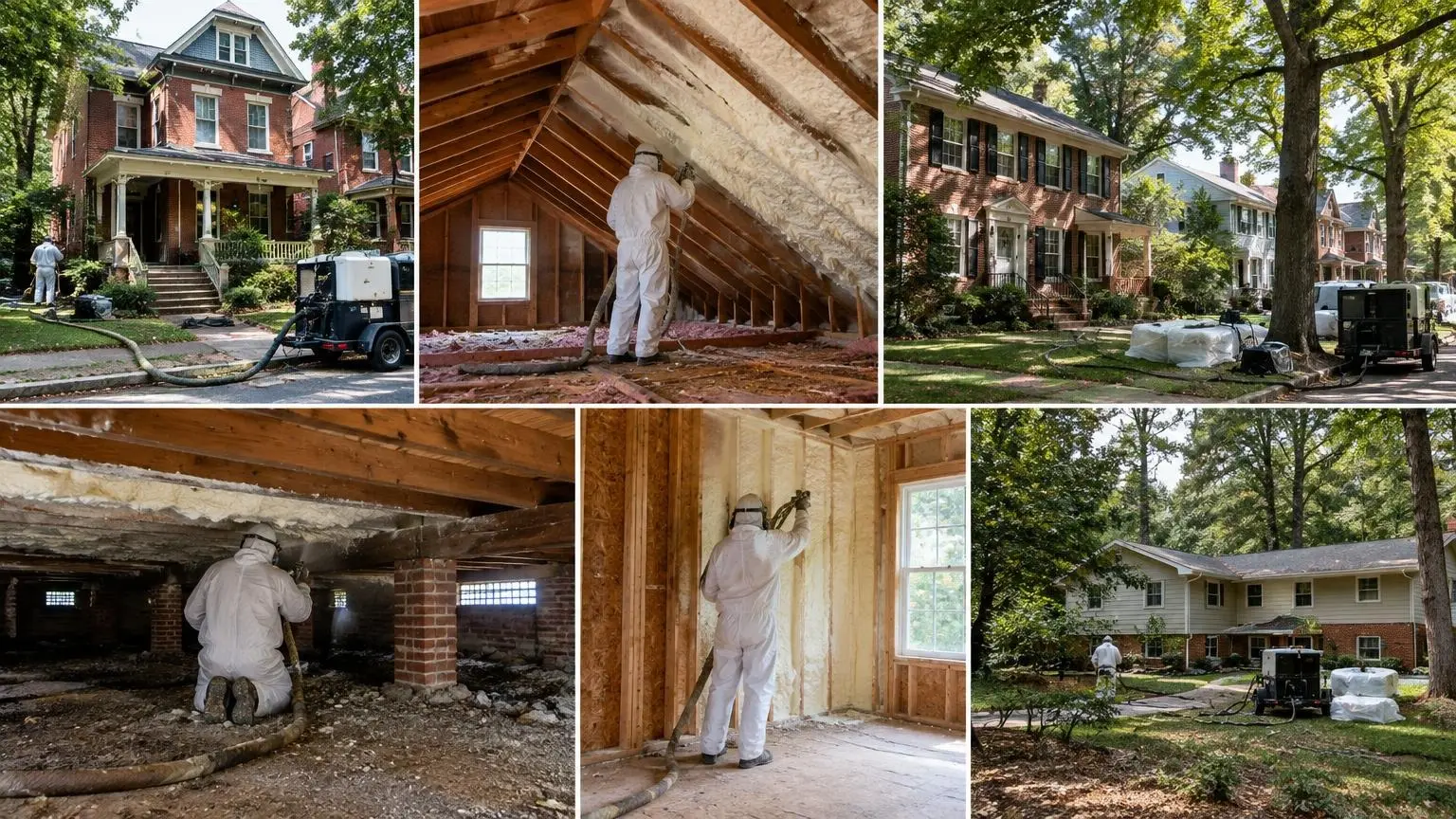
Attics, crawl spaces and walls in Central Virginia
Spray Foam Insulation in Richmond, VA
Seal the leaks, then insulate: open-cell or closed-cell foam, blown-in fiberglass or cellulose, chosen for each part of your house.
- Free on-site estimates
- Written, itemized quote with R-values
- Air sealing before any insulation goes in
Insulation for Hot, Humid Summers and Old Houses
Spray foam insulation in Richmond has two jobs: keeping summer heat out of the living space and keeping humid air out of the parts of the house where it causes trouble. Richmond has a humid subtropical climate. July averages 79.3°F, the high reaches 90°F or more on about 43 days a year, and average relative humidity sits near 75% in July and 77% in August. Winters are milder, with a January average of 37.9°F, but there are enough cold nights that a leaky house feels it. Insulation that ignores air leaks and moisture does not perform the way its label says.
Why air sealing comes first
Many comfort problems in Richmond houses come from air moving, not from a lack of insulation alone: hot attic air drifting down through recessed lights and wiring holes, or damp crawl space air rising through the floor. Fiberglass and cellulose slow heat but do not stop air. Spray foam does both, which is why it is the usual choice for rooflines, rim joists and odd-shaped gaps. On a standard attic floor, sealing the gaps with foam and caulk and then blowing in loose fill often gets most of the benefit for less money. ENERGY STAR estimates that sealing and insulating can save up to 10% on annual energy bills.
Open-cell or closed-cell foam
The two foams behave differently. HomeGuide lists open-cell foam at about R-3.5 to R-3.7 per inch and closed-cell at about R-5 to R-7 per inch. Open-cell is softer, lighter and cheaper, and it is common under roof decks and in walls. Closed-cell is dense, resists moisture and adds stiffness, so it suits rim joists, crawl space walls and anywhere water or ground moisture is a concern. The U.S. Department of Energy notes that open-cell foam can absorb water and should not be used below ground level. We pick the foam by location, not by habit.
What the Virginia code asks for
The 2021 Virginia Residential Code took effect on January 18, 2024. Henrico County's summary of the code puts the area in Climate Zone 4 and lists R-60 for ceilings with an attic, or R-49 installed uncompressed across the whole attic, including over the wall top plates. Chesterfield County issued a countywide modification in December 2024 that lets permit applicants use the lower ceiling values from the 2024 International Residential Code instead. These minimums apply to new construction and permitted work. For an existing attic, the Department of Energy's target for Zone 4 is R-60 if the attic is uninsulated, or adding R-49 if it already has 3 to 4 inches. Many older attics fall short of either.
Older homes in the city
Much of the Fan District was built between the Civil War and about 1920, and it has been on the National Register of Historic Places since 1985. Houses from that era were built with little or no insulation, and many have had pieces added over the decades: a layer of batts in one attic bay, loose fill in another, an addition with its own crawl space. Balloon framing, plaster walls and shallow attics change how insulation can be added. Dense-pack cellulose through small holes, or spray foam at the roofline where the attic is too tight to work in, are common answers, and the first step is always to find out what is already there.
Vented crawl spaces
Many Richmond-area houses sit on crawl spaces with foundation vents. In a humid summer, those vents let in warm, moist air, which meets cooler surfaces under the floor. Building Science Corporation's guidance is that crawl spaces should not be vented to the exterior and should be treated like small basements: a continuous sealed ground cover, insulated perimeter walls and rim joists, and some conditioned air or dehumidification. Not every house needs a full encapsulation, but if your crawl space smells musty, the floor feels cold in winter, or the batts under the floor are sagging, it is worth a look.
Dominion Energy's home energy program
Dominion Energy's Home Energy Evaluation program for Virginia customers offers a Comprehensive Home Energy Audit, a 2 to 4 hour visit by a participating contractor that unlocks rebates for insulation, air sealing and duct sealing. Its page does not publish the rebate amounts, and rebates depend on what the participating contractor recommends and installs. If you want to use it, check the current rules with Dominion before work starts. We are not part of Dominion and cannot promise a rebate.
What an attic insulation job includes
- Measuring the attic and the depth and type of what is there now
- Checking for roof leaks, rodent activity, mold and vermiculite
- Sealing top plates, wiring and plumbing holes, light boxes and the chase around the chimney or flue
- Weatherstripping and insulating the attic hatch or pull-down stairs
- Baffles at the eaves so soffit vents stay open
- Spray foam or blown-in insulation to the agreed depth, with depth markers left in place
Our Insulation Services
Six services cover the attic, the walls and the crawl space, from a full spray foam job to a top-up of blown-in insulation.
Spray Foam Insulation
Open-cell and closed-cell foam for rooflines, rim joists, walls and crawl spaces, sealing air leaks and insulating in one step.
Learn more →Attic Insulation
Air sealing plus blown-in, batt or spray foam insulation in the attic, built up to current R-value targets.
Learn more →Crawl Space Insulation & Encapsulation
Vapor barriers, sealed vents and insulated foundation walls for damp, musty or cold crawl spaces.
Learn more →Blown-In Insulation
Loose-fill fiberglass or cellulose blown into attics and closed walls to reach high R-values at a lower cost.
Learn more →Wall Insulation
Dense-pack insulation for closed walls and spray foam for open walls, without tearing out plaster.
Learn more →Insulation Removal & Replacement
Removing wet, moldy, rodent-damaged or compressed insulation and installing new insulation to current targets.
Learn more →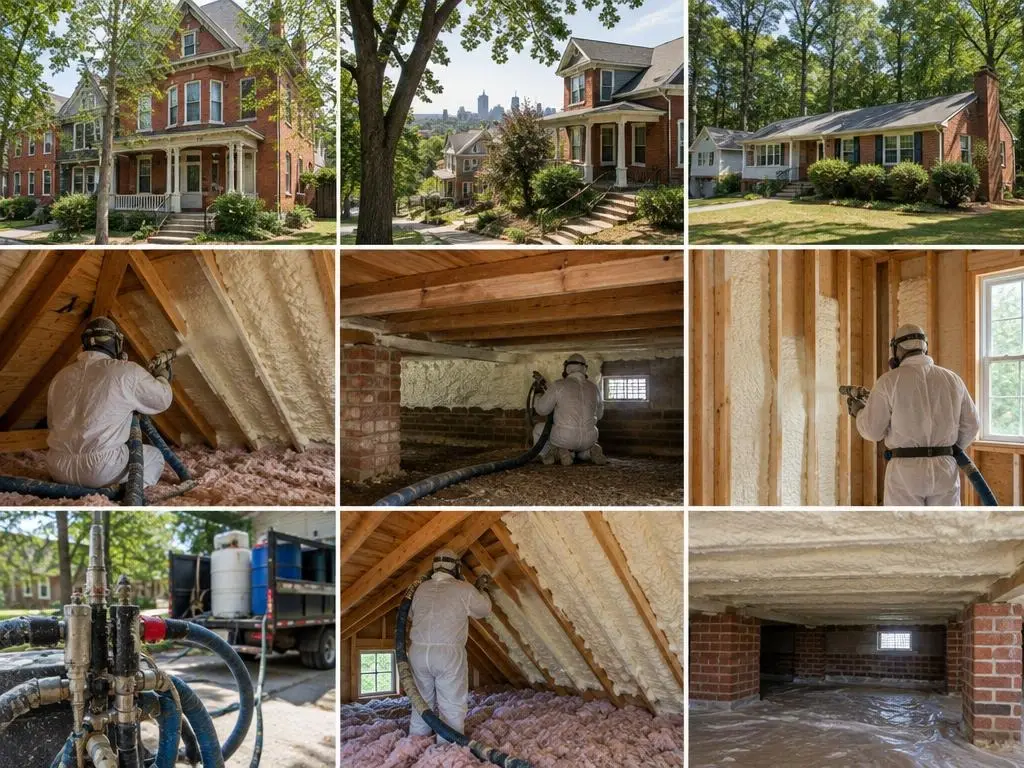
Where We Work
Richmond is the center of our service area, from the Fan, the Museum District and Church Hill to the Northside and the neighborhoods south of the James. We also work across Henrico County, including Glen Allen, Short Pump, Tuckahoe, Highland Springs and Sandston; Chesterfield County, including Midlothian, Chester and Bon Air; Hanover County, including Mechanicsville and Ashland; and nearby Goochland and Powhatan, Colonial Heights, Petersburg and Hopewell. The building code is the same statewide, but local building departments apply it: Chesterfield, for example, has a standing modification on attic R-values that Henrico's summary does not show. Housing differs too, from century-old brick in the city to 1970s and 1980s split-levels and newer homes in the counties. Each area page covers what applies there.
- Spray Foam Insulation in Richmond, VA
- Spray Foam Insulation in Henrico, VA
- Spray Foam Insulation in Short Pump, VA
- Spray Foam Insulation in Glen Allen, VA
- Spray Foam Insulation in Mechanicsville, VA
- Spray Foam Insulation in Chesterfield, VA
- Spray Foam Insulation in Midlothian, VA
- Spray Foam Insulation in Chester, VA
- Spray Foam Insulation in Bon Air, VA
- Spray Foam Insulation in Petersburg, VA
- Spray Foam Insulation in Colonial Heights, VA
- Spray Foam Insulation in Hopewell, VA
- Spray Foam Insulation in Ashland, VA
- Spray Foam Insulation in Highland Springs, VA
- Spray Foam Insulation in Sandston, VA
- Spray Foam Insulation in Tuckahoe, VA
- Spray Foam Insulation in Powhatan, VA
- Spray Foam Insulation in Goochland, VA
Why Homeowners Call Spray Foam Insulation Richmond
Leaks sealed first
Top plates, penetrations, the hatch and the rim joist are sealed before insulation covers them.
The right material for each spot
Closed-cell where moisture matters, open-cell or blown-in where it does not, explained line by line.
Problems checked before covering
We look for roof leaks, pests, wet wood and vermiculite before we insulate over anything.
A written quote with R-values
Each area, material, thickness and target R-value is listed with its price. Nothing is added without your approval.
Common Questions
Is it safe to be in the house during spray foam insulation?
No. Spraying releases isocyanate vapors, so the work area is closed off and ventilated, and you, children and pets should be out of the house while foam goes in. The EPA notes that some manufacturers recommend about 24 hours after application before re-occupancy, but times vary by product, thickness, temperature and humidity. We give you the manufacturer's re-entry time in writing before the job.
How much does it cost to spray foam 1,000 square feet?
HomeGuide's 2026 guide puts 1,000 square feet of sprayed surface at about $1,500 to $5,000, with open-cell at the low end and closed-cell at the high end. Fixr's range for existing homes is higher, $3,150 to $7,500. Depth, foam type and access move the price. We give a written number after measuring.
What is the R-value of 4 inches of spray foam?
Using HomeGuide's per-inch figures, 4 inches of open-cell foam is about R-14 to R-15, and 4 inches of closed-cell is about R-20 to R-28, depending on the product. Check the manufacturer's data sheet for the exact foam being installed; we list it on the quote.
How much does spray foam insulation cost in Richmond?
Homeyou's Richmond figure, based on customer reports for about 1,282 square feet, is roughly $1,981 to $2,477. National guides show wider ranges: HomeGuide lists attics at $3,000 to $8,000 and whole houses at $8,000 to $20,000. Many companies also have minimum job charges of $1,000 or more. Your written estimate is the price.
Is spray foam better than blown-in insulation for a Richmond attic?
It depends on the attic. If you want to move the HVAC equipment and ducts inside the insulated space, foam on the underside of the roof deck makes sense. For a standard vented attic with nothing in it, air sealing plus blown-in fiberglass or cellulose on the floor usually costs less for the same comfort. We show both options when both fit.
Do I need a permit to insulate my house in Richmond?
The City of Richmond's homeowner permit guide says permits are required for alterations and repairs, with exceptions in the code, and lists an insulation inspection before concealment for permitted work. It does not address insulation-only jobs directly. We check with the city or county building office for your address before scheduling.
Can Dominion Energy help pay for insulation?
Dominion's Home Energy Evaluation program lists insulation and air sealing among the upgrades that can earn rebates after a Comprehensive Home Energy Audit by a participating contractor. Its page does not give dollar amounts. Check the current rules with Dominion before starting work.
Get a Spray Foam Insulation Estimate
Free on-site estimates in Richmond and the surrounding counties.